
Behemoth meets Leviathan
The state & Big Tech are fusing. Time to act.

I’ve discovered a lot in the last 25 years. I’ve been allowed to range over every age of literature, every branch of science, every topic in philosophy, and, more recently, every sector of the technological vanguard. What a lush endowment! And the last few years, I’ve accelerated all this reading and synthesising with the new tools of AI itself.
It’s only now, for the first time really, that I have anything actually consequential to say. I feel like Jack in The Importance of Being Earnest:
Gwendolen, Cecily, it is very painful for me to be forced to speak the truth. It is the first time in my life that I have ever been reduced to such a painful position
Recent AI developments are illegible to most commentators, but are well explained by my framework. My diagnosis of how we misunderstand human thinking is every day born out by some new argument over whether and how machines think, reason, use language, plan, learn, and show agency.
And every day my feed is clogged with wishful thinking. Elon Musk will do what he says he will. AI won’t take your job. The government wouldn’t spy on you illegally. Oh my.
Perhaps one day machines will destroy democracy for reasons only I understand. Because I care much more about intellectual vindication than human civilisation, this will be great. In the meantime, I’m switching on paid subscriptions to the Stark Way.
What is the Stark Way?
The Stark Way is my approach to this shifting, sublime terrain. It’s summed up in the following points:
Since the 1950s, we’re in a genuinely new epoch. Cognitive science, computation, information theory, etc., turned the scientist’s instruments away from an odd-looking world, onto the scientist themself, revealing that the scientist and the way they see is also very odd.
Our innate worldview doesn’t fit the terrain. Our intuitive notions of things like agency, knowledge, learning, aboutness, perspective, are inadequate for navigating new phenomena like AI, brain-computer interfaces, designer babies, post-democracy, etc. We can’t rely on our inherited view; we need a new way.
The Stark Way is deliberately negative. It’s mainly about discarding what doesn’t work. Scepticism, no wishful thinking, pragmatism, etc.
Novel futures are fundamentally unpredictable. The systems we’re trying to understand (agents, politics, AI, evolution) are interactive and produce unprecedented results. History is no guide; forecasting is science fiction.
AI is a nexus for our time’s imponderables: the nature of art, consciousness, and language; democracy, surveillance, privacy; China, America, and Big Tech; asymmetric warfare, cyber-terrorism, nuclear weapons; work, leisure, and the meaning crisis.
Nothing in current events has yet undermined my approach to these topics.
So now I’m turning to practice. I’ve had the privilege of drinking deep from the draught of modern knowledge. But I neglected things like politics, international relations, and policy, i.e. how things get done. This is where the Stark Way is going now.
One word you might have skipped over in the above is irony. We live in grossly ironic times. The only people knowledgable enough about the threat of AI are the ones who truly believe it could become a benevolent god. So they continue an arms race which they also believe might kill us all, including their own children. The man many believe most likely to build this god, Anthropic’s CEO, is actually named Amodei. Meanwhile, those who should be most appalled by the current threat of hijacking democracy, are, by inclination, prone to think that Big Tech are simply hyping their product to garner more investment. Their scepticism of the men is admirable, but perversely extends into scepticism of the machines which are far more real than the rhetoric.
The finest irony of the age, though, is the notion of alignment. The people building the increasingly powerful systems worry about aligning them with humanity’s interests. Their critics scoff: simply instil it with the right values then it doesn’t matter how powerful it is! Yet humanity cannot even align these companies’ values with our own, nor exert any control over them as they become increasingly powerful as lobby groups, military contractors, and agenda-setters. Instead, we are currently paying them to remember our credit card details, hear our confessions, do our jobs, monitor our biorhythms, and watch our children while they sleep. This is the real alignment problem and though it is ironic it isn’t funny.
It’s happening now
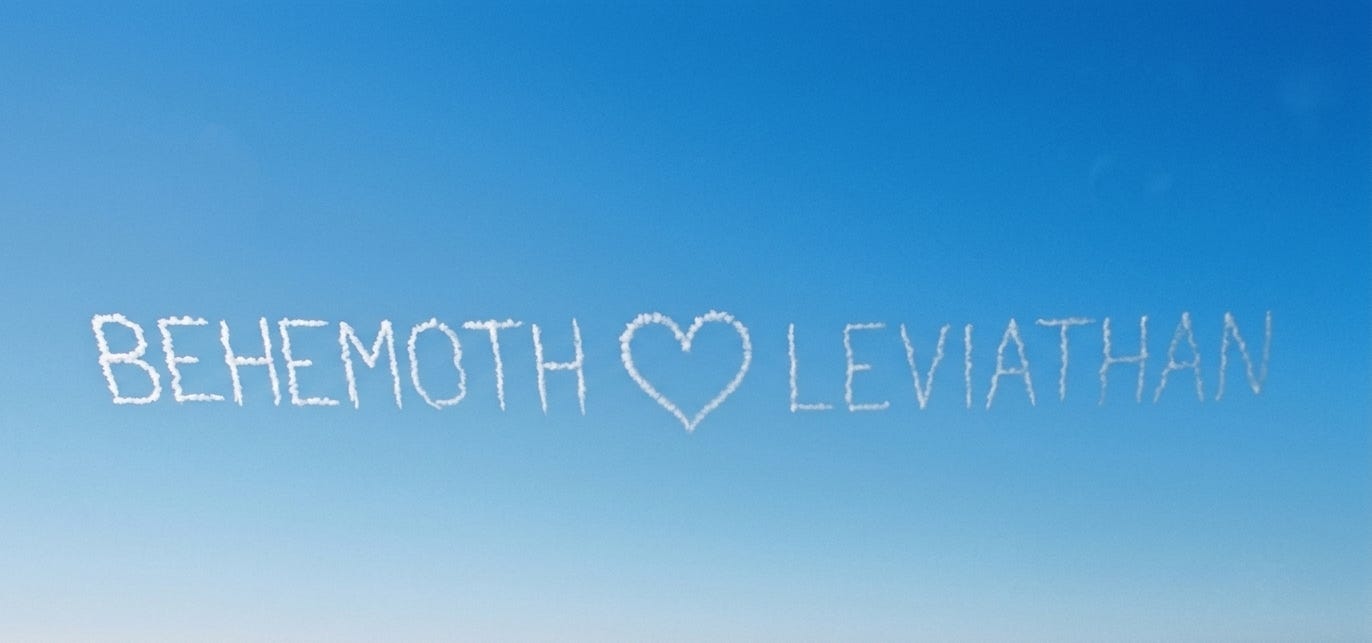
The threat to democracy — or whatever you care about — is written across the sky in large letters. Wake up. The real alignment problem is between us and more powerful entities.1
In this sense, we can somewhat “align” our governments only because we can protest, petition, sue, and vote them out. Without these control mechanisms there is no way to stop a powerful state from doing whatever it wants at your expense. This is politics 101, history 101, cynicism 101, common sense 101.
A powerful corporation is likewise “aligned” only to the extent it can be compelled by laws and is not too big to fail. In the last 15 years, Big Tech have transformed into the most powerful set of corporations ever. Amazon, Google, Nvidia, and Microsoft — at least — would never be allowed to collapse, not because they offer consumer goods used by billions, but because they own the infrastructure on which the modern economy depends.
Simultaneously, Big Tech has merged with the state, especially via intelligence agencies and militaries. In China, the merger is how the authoritarian system is meant to work. In the US, it is utterly contrary to all the principles of government that people on both sides of politics publicly espouse. In my country, Australia, it’s happening virtually without comment, let alone protest.
It had already started with the advent of social media and big data in the 2010s. Few people from any political stripe offered any resistance. A glowing exception was the work of Shoshana Zuboff. Now, in the age of AI, all the Faustian trends she catalogued are accelerating rapidly.
The latest instance — which happened while I was writing this — is Anthropic’s clash with the Department of Defense over the use of their products for mass surveillance of the American public by their own government. Anthropic refused to allow Claude and related products to be used either for mass surveillance or developing fully autonomous weapons. The Pentagon thuggishly dropped them and threatened to commercially destroy them. Waiting patiently at the threshold, in black poodle form, was OpenAI’s CEO Sam Altman, who immediately signed the pact that Amodei wouldn’t and then slunk away from the now misshaped pentagram.
This makes Anthropic the least bad of a very bad bunch.2
Before celebrating with a Claude subscription, however, consider that in the same week Anthropic relaxed the wording of their own “Responsible Scaling Policy”. It used to read, in 2023:
We will not train or deploy models capable of causing catastrophic harm unless we have implemented safety and security measures that will keep risks below acceptable levels.
Sounds like the bare fucking minimum — which they can no longer promise. In February 2026, they said, “We didn’t really feel, with the rapid advance of AI, that it made sense for us to make unilateral commitments… if competitors are blazing ahead”. In other words, if you can’t beat ‘em at saving the world, join ‘em at destroying it. They’re in the middle of a good ole arms race, the kind that has been endlessly discussed for the last 15 years among the cognoscenti, including by Amodei himself at times.
People think they can safely ignore this arms race, because future superintelligence is science fiction (which strictly speaking it is; remember, I don’t think anyone can forecast the future). Regardless of whether superintelligence is near or possible, the AI arms race is 100% the number-one or number-two problem right now in every democracy. But the unaligned, powerful monster currently gestating is Big Tech meets Big Government: Behemoth plus Leviathan. Superintelligence would be the cherry on top, or perhaps the catalyst of this process. Regardless, an AI-augmented concentration of power is happening and the window is closing to reassert control. Laws need to be updated or created. Citizens need to form movements. Politicians need to have their eyes taped open. Legislatures need to bring militaries to heel. Big Tech needs to be spayed, neutered, declawed, and defanged.
Why pay for the Stark Way?
I think this is important and I see virtually no one else with my background addressing it; the near future will require new ways of understanding increasingly weird shit. The research and advocacy of the Stark Way is otherwise not funded. I will continue to do it, funding it myself, but help would be appreciated.
The main offering of the Stark Way will remain free in any case:
My primary posts about the nexus of AI, human cognition, reading, meaning, and the occasional rant about nuclear weapons will be free for every citizen of the world. I aim to increase from approx. 10 posts a year to approx. 15.
Comments are free.
Short videos of me and longer interviews with other people.
Extra stuff for paying supporters will include:
Audio versions of the posts, read by me in my authentic Wollongong accent.
Bonus writing at the end of the main post.
Other ideas suggested by you.
From day 1, the Stark Way’s rules were simple. There are only three. I’ve covered (1) no wishful thinking and (2) no forecasts. Number (3) is: no censorship or vested interests.
I’ve never followed intellectual fads. I’m independent, having never been a member of any political party. I think I’ve evaded ideological capture. I have no institutional allegiance. In fact I’ve blown the whistle or called-out fraud in three organisations I’ve worked for. This hasn’t been a great career move, but I’ve so far remained incorruptible.
And “vested interests” also includes you! The paid option is for those willing to help me cover some costs. I don’t want to write whatever gets the most likes or subs.
Upcoming posts
My best writing is ahead of me (partly because most of my good ideas are trapped in the academic publishing pipeline, where they do no one any good). Here are just some of the posts planned for 2026:
AI agents are now everywhere, with the technology finally getting smooth enough to handle many business and personal tasks. What are their limits? Hey, this just happens to be my area of specialty… and even I don’t know. So probably no one else does. But I think I know how to figure it out.
Billions of dollars are being invested in humanoid domestic robots that will one day fold your laundry and stack your dishwasher. There is a deceptively simple reason, however, why it will be some time before they have a hope of working. In the meantime, they’ll be used on the battlefield.
As readers, one of the laziest things we can do is to conflate the author with the protagonist. But the laziest kind of writer is one who can only “write what they know”, producing protagonists who essentially are ciphers of themselves. Bad writers thereby make bad readers. How do we break out of this?
So for this and more, join me on the Stark Way, share it with your friends, and consider becoming a paid subscriber.
Thanks to Clyde Rathbone, an old friend, who works at Substack and who gave me some advice and info on turning pro.
The original “alignment” predates our species. Once our ancestors could throw rocks and talk, they could conspire to kill the most tyrannical males. This method of control aligned leaders’ interests with the less powerful, on pain of death.
I maintain a little league table of how evil the Big Tech companies are. Here it is as of March 2026 (most evil to least evil): Palantir, Meta, Amazon, Google, Tesla/xAI, OpenAI, Microsoft, Nvidia, Apple, Anthropic. I don’t know enough to rank the Chinese players (Baidu, Alibaba, Moonshot, Tencent, ByteDance, DeepSeek, etc.), but they look ghastly. Consider using Confer for AI and Signal for messaging.
Jamie, this is powerful—raw, ironic, and unflinchingly clear. Thank you for naming the grotesque merger of Big Tech + state power and refusing the usual hopium or denial.
The exhaustion and dark humor come through, but writing this, launching the Stark Way, and now turning toward policy/activism shows you’re still fighting for clarity and pushback. That matters—a lot.
The threats are real and accelerating, but your independent, skeptical lens is rare and needed. Enough people are starting to see it too, and history shows concentrated power can be checked when voices like yours refuse to fold.
You’re not alone. Keep going—the Stark Way is becoming a vital compass. Just upgraded; excited for what’s next.
Stay incorruptible. We need exactly that.